
Measuring Earthquake Energy: Richter Scale to TNT Equivalent Explained
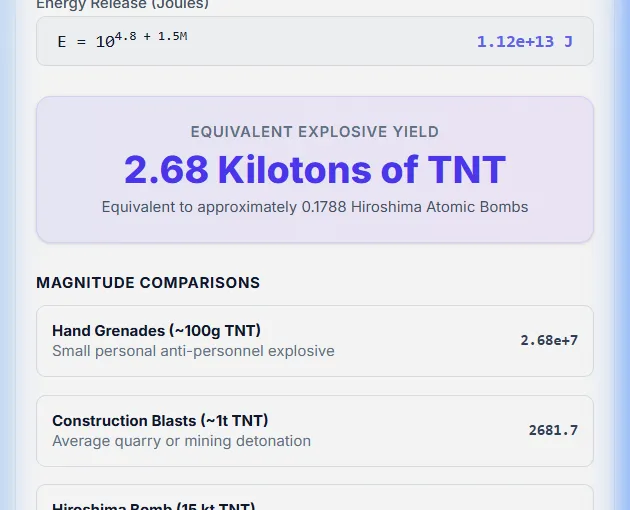
When a major earthquake strikes, the news media immediately reports its magnitude on the Richter Scale (or more modernly, the Moment Magnitude Scale). We hear numbers like “magnitude 5.0” or “magnitude 7.0.”
However, because the Richter Scale is a logarithmic scale, the human brain struggles to comprehend the sheer scale of difference between these numbers. A magnitude 7.0 earthquake isn’t just “two units” stronger than a 5.0—it is actually 1,000 times more energetic.
To help visualize this power, geologists and physicists often convert earthquake energy into TNT equivalent weight. In this article, we’ll explain the logarithmic math of earthquakes and how to calculate their energy in tons of TNT.
The Logarithmic Math of Magnitude
The Richter Magnitude Scale is logarithmic, specifically designed to handle the massive range of ground vibrations recorded by seismographs.
While seismograph wave amplitude increases by a factor of 10 for every increase of 1.0 in magnitude, the energy released increases by a factor of approximately 31.6 (or more precisely, $10^{1.5}$).
$$\text{Energy Factor Increase} = 10^{1.5 \times (M_1 - M_2)}$$
If we compare a magnitude 7.0 to a magnitude 5.0:
- The difference in magnitude ($M_1 - M_2$) is $2.0$.
- The energy increase is $10^{1.5 \times 2} = 10^3 = 1,000$.
This means a single 7.0 earthquake releases the same energy as 1,000 magnitude 5.0 earthquakes combined!
Calculating Energy in Joules
The scientific formula that relates an earthquake’s magnitude ($M$) to the seismic energy released in Joules ($E$) is known as the Gutenberg-Richter relation:
$$\log_{10}(E) = 4.8 + 1.5M$$
By raising 10 to the power of both sides, we can calculate the energy in Joules directly:
$$E = 10^{4.8 + 1.5M}$$
- Magnitude 3.0 (Barely felt): $10^{4.8 + 1.5(3)} = 10^{9.3} \approx 2 \times 10^9 \text{ Joules}$.
- Magnitude 6.0 (Strong, damages buildings): $10^{4.8 + 1.5(6)} = 10^{13.8} \approx 6.3 \times 10^{13} \text{ Joules}$.
Converting to TNT Equivalent
Because Joules are too small to visualize easily, we use TNT equivalents. One gram of TNT is defined to release 4,184 Joules of energy (or $4.184 \times 10^9 \text{ Joules}$ per metric ton of TNT).
To convert Joules ($E$) to tons of TNT ($W_{\text{TNT}}$):
$$W_{\text{TNT}} = \frac{E}{4.184 \times 10^9}$$
Combining our formulas, we get a direct calculation for TNT weight:
$$W_{\text{TNT}} = \frac{10^{4.8 + 1.5M}}{4.184 \times 10^9}$$
Let’s look at real magnitudes in TNT:
- Magnitude 1.0: Equivalent to about 480 grams of TNT (roughly a hand grenade).
- Magnitude 3.0: Equivalent to about 480 kilograms of TNT (a small construction blast).
- Magnitude 5.0: Equivalent to about 480 tons of TNT (comparable to a tactical military explosive).
- Magnitude 6.0: Equivalent to about 15,000 tons (15 Kilotons) of TNT (the size of the atomic bomb dropped on Hiroshima).
- Magnitude 8.0: Equivalent to 15,000,000 tons (15 Megatons) of TNT (comparable to large thermonuclear weapons).
- Magnitude 9.5 (The 1960 Valdivia Earthquake, the largest ever recorded): Equivalent to 2.7 billion tons (2.7 Gigatons) of TNT!
Compute this dynamically using our interactive workspace— Earthquake Energy to TNT Calculator
Open the live calculator on WebCalcSys.com to plug in your own numbers, view graphs, generate reports, and clone notion-style calculation documents.
Frequently Asked Questions (FAQ)
Find quick answers to common questions about Earthquake Energy to TNT Calculator.