
How to Calculate GPA: A Step-by-Step Guide for High School & College Students
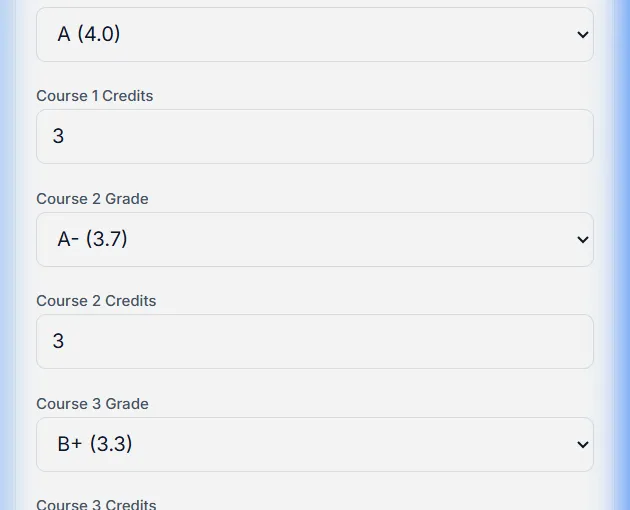
Your Grade Point Average (GPA) is one of the most critical metrics in your academic journey. It summarizes your overall performance and is heavily used for college admissions, scholarships, and job applications.
While calculating your GPA might seem daunting, it is actually a straightforward math formula once you understand how credit hours and grade points work together. In this guide, we will break down exactly how to calculate both your semester GPA and cumulative GPA step-by-step.
The Standard 4.0 GPA Scale
Most high schools and universities in the United States use a standard 4.0 unweighted grading scale. Each letter grade you receive is assigned a numeric value:
| Letter Grade | Percentage | Grade Points (Unweighted) |
|---|---|---|
| A | 90% – 100% | 4.0 |
| B | 80% – 89% | 3.0 |
| C | 70% – 79% | 2.0 |
| D | 60% – 69% | 1.0 |
| F | Below 60% | 0.0 |
If your school uses plus and minus grades (e.g., A-, B+), the points are slightly adjusted (for example, an A- is usually 3.7 and a B+ is 3.3).
How to Calculate Semester GPA (Step-by-Step)
To calculate your GPA for a single semester, you cannot just add your grades together and divide by the number of classes. You must account for Credit Hours (the weight of each class). A 4-credit science lab affects your GPA much more than a 1-credit physical education course.
Here is the 4-step formula:
Step 1: Convert Letter Grades to Grade Points
For each class, look up the letter grade in the table above and write down its corresponding grade points.
Step 2: Multiply Grade Points by Credit Hours
For each course, multiply its credit hours by its grade points. This gives you your Quality Points for that course. $$\text{Quality Points} = \text{Credit Hours} \times \text{Grade Points}$$
Step 3: Sum Credits and Quality Points
Add up the total number of credit hours you took. Then, add up the total quality points you earned.
Step 4: Divide Total Quality Points by Total Credits
Divide your total quality points by your total credits to find your GPA: $$\text{GPA} = \frac{\text{Total Quality Points}}{\text{Total Credit Hours}}$$
Real-World Example Calculation
Let’s say you took 4 classes this semester. Here is how your worksheet looks:
| Class | Letter Grade | Grade Points | Credit Hours | Quality Points Calculation |
|---|---|---|---|---|
| English 101 | A | 4.0 | 3 | $4.0 \times 3 = 12.0$ |
| Calculus I | B | 3.0 | 4 | $3.0 \times 4 = 12.0$ |
| Biology Lab | C | 2.0 | 4 | $2.0 \times 4 = 8.0$ |
| Public Speaking | A | 4.0 | 2 | $4.0 \times 2 = 8.0$ |
| Totals | 13 Credits | 40.0 Quality Points |
Now, apply the final step: $$\text{GPA} = \frac{40.0}{13} \approx 3.08$$
Your semester GPA is 3.08 (a solid “B” average).
How to Calculate Cumulative GPA
Your Cumulative GPA is the average of all grades you have received across all semesters.
To calculate it:
- Do not simply average your semester GPAs together (unless every semester had the exact same number of credits).
- Instead, add up the total quality points earned across all semesters.
- Add up the total credit hours taken across all semesters.
- Divide the absolute total quality points by the absolute total credits.
This ensures your GPA is weighted correctly over your entire academic career.
Compute this dynamically using our interactive workspace— GPA Calculator
Open the live calculator on WebCalcSys.com to plug in your own numbers, view graphs, generate reports, and clone notion-style calculation documents.
Frequently Asked Questions (FAQ)
Find quick answers to common questions about GPA Calculator.