
The Science of Sports Metrics: How Athletes Use Calculations to Train Smarter
Modern sports training is no longer just about working hard; it is about working smart. Behind every Olympic champion or elite runner is a team of sports scientists tracking specific, mathematically computed physiological metrics.
By translating athletic effort into data points, athletes can identify precise zones of cardiorespiratory and muscular stress. In this guide, we’ll explain three essential sports calculations that every runner, cyclist, and fitness enthusiast should know: VO2 Max, Target Heart Rate Zones, and Pace/Split distributions.
1. VO2 Max: The Ultimate Cardio Metric
VO2 Max (Maximal Oxygen Uptake) measures the maximum volume of oxygen your body can utilize per minute of intense, all-out exercise. It is widely considered the gold standard metric for cardiorespiratory fitness.
VO2 Max is expressed in milliliters of oxygen consumed per kilogram of body weight per minute ($\text{mL/kg/min}$):
$$\text{VO2 Max} = \frac{\text{Max mL of } O_2 \text{ consumed}}{\text{Weight in kg} \times \text{Time in minutes}}$$
How to Calculate VO2 Max Without a Lab
While a metabolic cart lab test is most accurate, you can estimate your VO2 Max using the Cooper 12-Minute Run Test. You run as far as you can in 12 minutes, record the distance in meters ($d_{12}$), and plug it into this formula:
$$\text{VO2 Max} = \frac{d_{12} - 504.9}{44.73}$$
- Example: If you ran 2,700 meters in 12 minutes: $$\text{VO2 Max} = \frac{2700 - 504.9}{44.73} \approx 49.07 \text{ mL/kg/min}$$
A VO2 Max of 49 is considered excellent for a young adult, while elite marathoners often exceed 80 mL/kg/min!
2. Heart Rate Zones & The Karvonen Formula
Training in the right heart rate zone is critical for building either aerobic endurance or anaerobic speed. Rather than using the simple $220 - \text{age}$ formula, elite coaches use the Karvonen Formula, which factors in your Resting Heart Rate (RHR) to find your Heart Rate Reserve (HRR).
The Karvonen Formula:
$$\text{Target Heart Rate (THR)} = (\text{HRR} \times \text{Intensity %}) + \text{RHR}$$ Where: $$\text{HRR} = \text{Max Heart Rate} - \text{Resting Heart Rate}$$ $$\text{Max Heart Rate} \approx 220 - \text{Age}$$
Example Zone Calculation:
For a 30-year-old with a Resting Heart Rate of 60 bpm, wishing to train at 70% intensity:
- Max HR = $220 - 30 = 190 \text{ bpm}$
- HRR = $190 - 60 = 130 \text{ bpm}$
- Target HR = $(130 \times 0.70) + 60 = 91 + 60 = 151 \text{ bpm}$
This athlete should aim for 151 bpm to maintain an aerobic steady-state threshold.
3. Running Pace & Race Splits
When preparing for a race (like a 5K, 10K, or Marathon), running at a consistent pace is the most energy-efficient strategy. Pace calculations help you break down your overall time goal into mile splits or kilometer splits.
$$\text{Pace} = \frac{\text{Total Time}}{\text{Total Distance}}$$
If your goal is to finish a 10K (10 kilometers) in 50 minutes: $$\text{Pace} = \frac{50 \text{ minutes}}{10 \text{ km}} = 5 \text{ minutes per kilometer}$$
Knowing this split allows you to check your smartwatch at every kilometer marker to ensure you are not running too fast (which triggers early fatigue) or too slow.
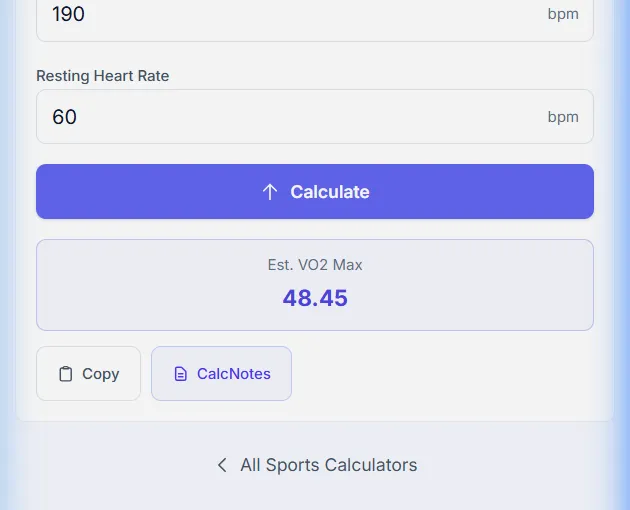
Compute this dynamically using our interactive workspace— VO2 Max Calculator
Open the live calculator on WebCalcSys.com to plug in your own numbers, view graphs, generate reports, and clone notion-style calculation documents.
Frequently Asked Questions (FAQ)
Find quick answers to common questions about VO2 Max Calculator.